essay
If you want a hill out there, you weld one
Why the Midwest hangs a million gallons of water off a pole, while Arizona pours the same machine into a hillside.
I spend a good chunk of my summer in Connecticut, and a few weeks back I flew out to the Lombard office to run some training. Somewhere on the descent into Chicago I looked out the window and finally noticed something I have flown over my whole life without registering it. Water towers. One in every neighborhood, sitting between the houses and the ballfields like each subdivision got issued one at closing.
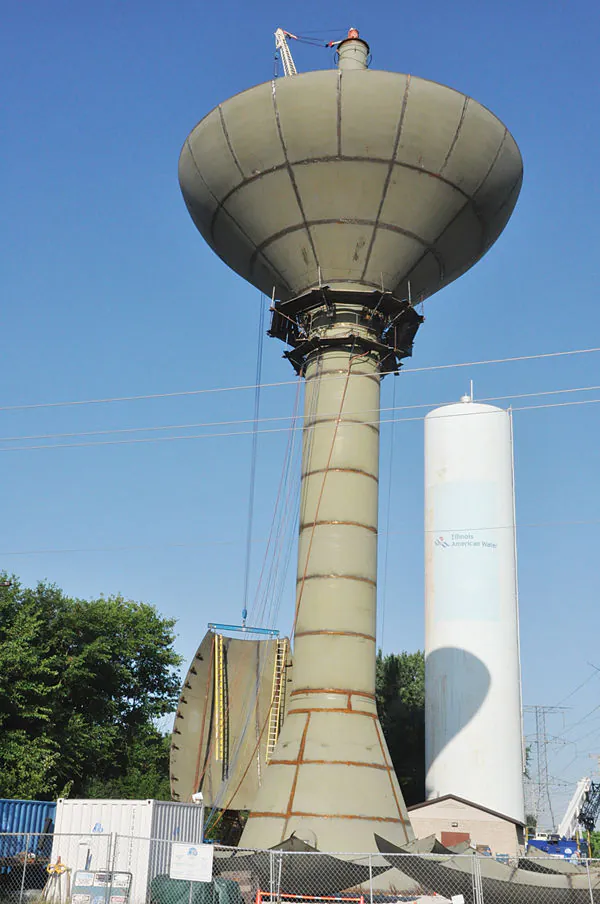
Then on the drive back to O’Hare we passed one that wasn’t finished yet. No crew on it, nothing moving, just the bare structure sitting in a lot. You never see one of them half-assembled, and it was the first time it registered how much steel goes into keeping water up in the air.
I grew up in Arizona. My first honest thought was: who signed off on putting that much water up there where anybody can see it?
Because that is not how water works where I’m from. In Arizona water is a legal document. Before a builder can sell you one lot in a Phoenix subdivision he has to prove to the state there’s a hundred-year water supply behind it. That framework dates to 1980 and we are still arguing about whether it’s working. Water is something you account for and litigate and mostly keep underground. Then you fly into a city that drinks out of a lake holding a fifth of all the fresh surface water on Earth, and the local instinct is to hang a million gallons of it off a pole downtown and paint the town’s name on it.
So I looked up what they’re for.
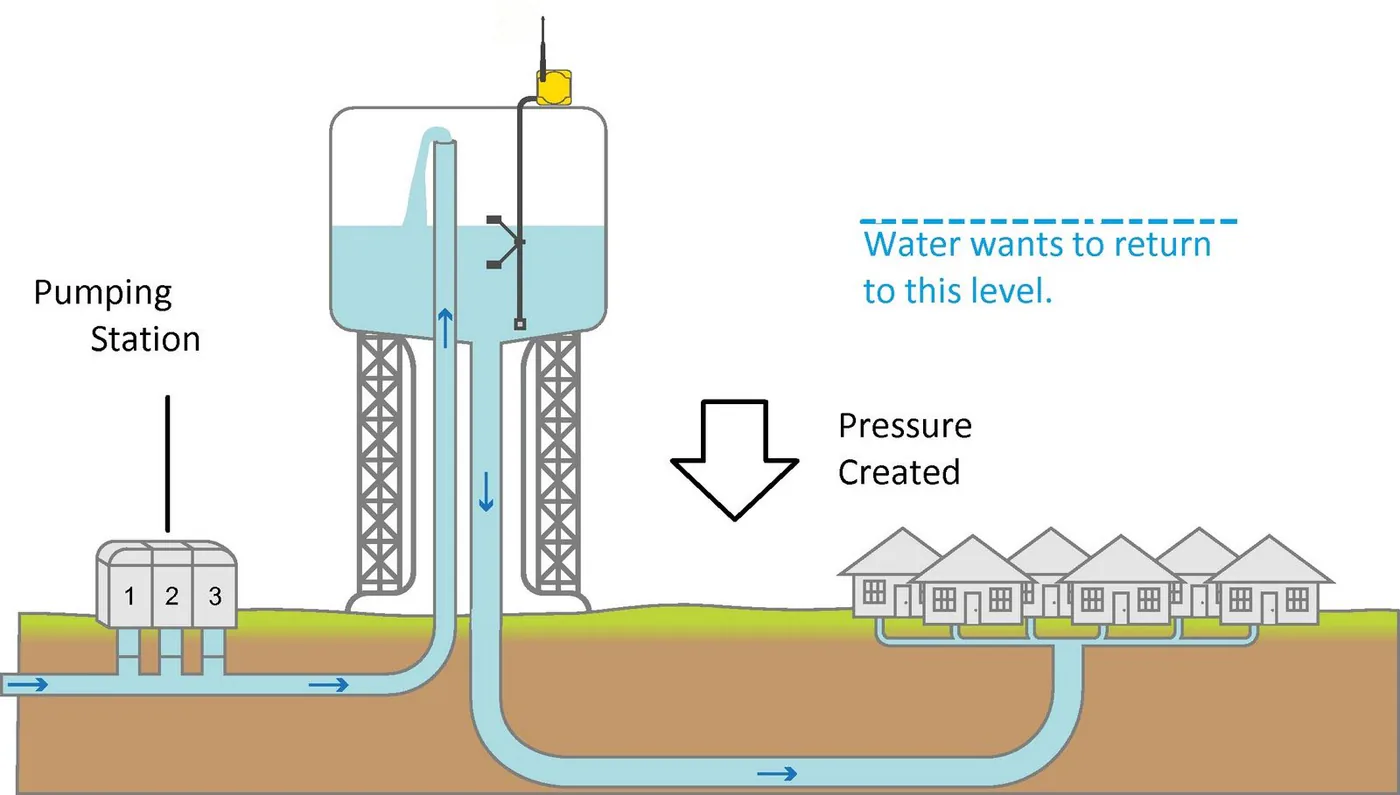
A water tower is a battery that stores water instead of electricity. It charges overnight and discharges during the day.
Every foot of height buys you 0.43 PSI, and your house wants somewhere between 50 and 100. So a tank sitting a hundred feet up delivers about 43 PSI to every tap underneath it without a pump running. Gravity works the day shift.
Without the tower, a city has to size its pumps for the worst ten minutes of the morning shower rush and then let all that horsepower idle at 2 a.m. With one, you run smaller pumps at a steady rate, fill the tank overnight while nobody’s using water, and let the tank cover the peak. The town also holds pressure for a while if the power drops, because gravity doesn’t need electricity.
The other reason, and the one that explains why a town of four thousand people bothers, is fire. Insurance companies grade a community’s fire protection on an ISO Public Protection Classification, and water supply is 40% of the score, nearly as much as the fire department itself. Fire losses in a Class 9 town run about 65% higher than in a Class 5. So the tower with the town name painted across it is a little bit civic pride and mostly an insurance-rate decision somebody made at a council meeting decades ago.
Gaffney, South Carolina ran with that harder than anyone. Their water board needed elevated storage and wanted federal money to help cover it, so in 1981 they built the tank in the shape of a peach. A million gallons, 135 feet tall, still serving the north side of town.
So why doesn’t Arizona have them?
Mostly because we have hills. A tower is a way to buy elevation, and we already own plenty of it. Pour a concrete tank into the side of the nearest ridge and it works exactly like a tower for a fraction of the money. Phoenix does that, along with ground reservoirs and pumps that hold pressure across the system. Northern Illinois and the Connecticut river valleys don’t get that option. If you want a hill out there, you weld one.
There’s a second thing going on though, and it’s the part I was actually reacting to from the passenger seat. Out there water is the boring input. You’re sitting next to the lake, the hard problem is moving it and pressurizing it, and parking a day’s supply overhead is just sensible. Here it’s the thing every other decision bends around, and we would rather keep it where it can’t evaporate.
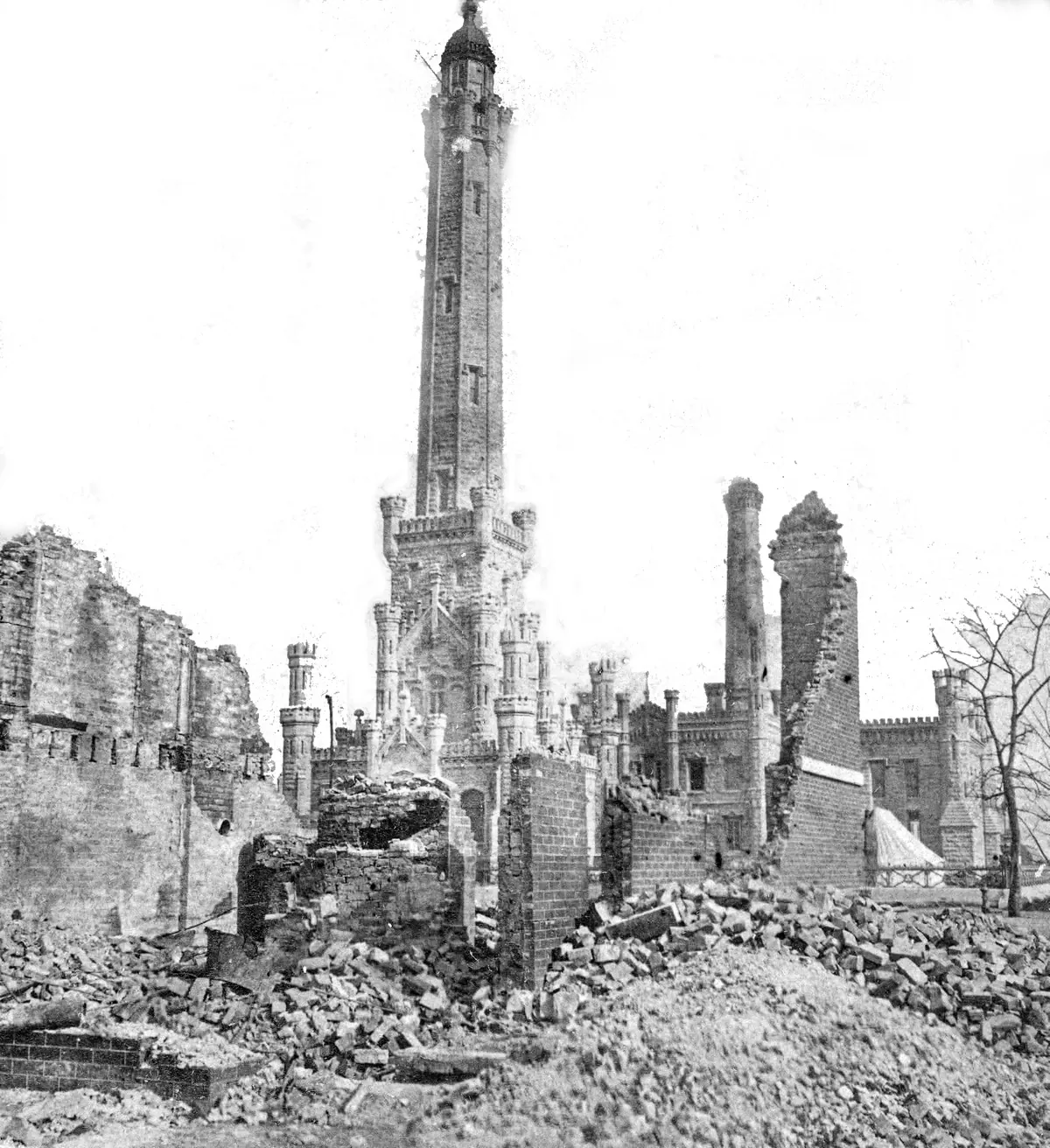
Chicago’s most famous water tower, for what it’s worth, never held a drop. The stone castle on Michigan Avenue went up in 1869 as a decorative sleeve around a 138-foot iron standpipe whose only job was to swallow the pressure surges coming off the pumping station so the mains didn’t hammer themselves apart. Two years later the Great Fire came through and it was the only public building left standing in the burn zone. Partly that’s the Joliet limestone, which barely burns. Partly it’s a German immigrant fireman named Frank Trautman, who spent the night draping the building in wool blankets and old canvas sails and keeping them soaked with lake water. Oscar Wilde saw it in 1882 and called it “a castellated monstrosity with pepper boxes stuck all over it,” which is both mean and accurate.
Flying home I picked out three tanks sitting on ridgelines I have driven past my entire life and never once thought about. Same machine as the half-built one on the way to O’Hare. We just got the hill for free.
Further research
- How water towers work (HowStuffWorks)
- Why water supply is 40% of your town’s fire grade (Fire Engineering)
- Arizona’s 1980 Groundwater Management Act and the 100-year rule (Arizona Department of Water Resources)
- The Chicago Water Tower and the fireman who saved it (Chicago Architecture Center)
Stay curious.